Horse As Teacher, The Path to Relationship is now available for purchase. Click here for details!
 |
 |
 |
Archive for the ‘Hoofcare’ Category
Hoof Nutrition for Healthy Hooves
Editor’s Note: This article has been sourced from Riva’s Remedies and has been originally written by Equine Health & Nutrition Specialist, Marijke van de Water
Horse hooves require a tremendous amount of nutrition including protein, sugars, vitamins, and minerals. These nutrients are delivered by a generous blood supply through hundreds of blood vessels to stimulate growth and repair. The hoof wall is composed of 95% keratin, a tough insoluble and colourless protein that is rich in sulphur-containing methionine (an amino acid). The formation of keratin also requires adequate amounts of zinc and biotin. It is for this reason that many traditional hoof supplements contain these specific nutrients to support and strengthen the hoof wall. If these nutrients are truly deficient then these supplements will be helpful; however if there is no deficiency present benefits will be negligible. At this point it is useful to seek out other nutrients that can make a difference to hoof strength and structure – minerals such as sulphur, selenium, and silica are significant in overall hoof health. Silica promotes bone health, strengthens collagen and hardens the hoof wall, while selenium and sulphur contribute to collagen production and strengthen the cross link bonds in the keratin.
Sulphur is a critical nutrient for strengthening the amino acids (protein units) that serve as major building blocks in healthy collagen to form a strong hoof wall. Collagen fibres are naturally occurring proteins found exclusively in animals and they are the main proteins in all connective tissues. Collagen fibre makes up 25% to 35% of the whole body protein – its main function is to support and give structure to all the tissues around the cells. Since it has excellent tensile strength, collagen is the main component of cartilages, tendons, ligaments, skin and hoof wall. The fibres in hoof wall are very compact and dense. The strength of these fibres is increased by their unique structure – they twist, intersect and cross with each other. Sulphur molecules create very strong cross-links that hold the fibres together.
Obvious signs of sulphur deficiency include poor hoof growth, dry and cracking hooves, poor hair coat, skin conditions and allergies. Sulphur can be supplemented using Riva’s Flower Power which is pure ground sulphur fed at one tablespoon daily which equals 14 g of sulphur. This is also an excellent supplement for “scratches”.
Riva’s Circu+Plus contains pine bark extract which not only has natural levels of both sulphur and silica for strengthening and repairing hoof tissue but is also an anti-oxidant and natural anti-inflammatory that improves hoof circulation. Circu+Plus also contains Magnesium to relax any hoof tension, reduce pain and improve metabolism. Circu+Plus is an excellent supplement for acute and/or chronic laminitis. Feed one to two tablespoons daily: one tablespoon contains 200 mg of pine bark extract and 1,000 mg of magnesium citrate.
Sulphur is also very beneficial in homeopathic form as it helps to improve the metabolism of existing sulphur by increasing its absorption and utilization at the cellular level. Give one dose of Sulphur, 200C (5 pellets) – twice daily for 4 days.
A selenium deficiency in the hoof can appear as horizontal cracks near the top of the hoof below the coronet band, a yellowing frog and/or lameness due to either weak hoof structure or strained ligaments and tendons. Systemic symptoms of deficiency can include poor hair coat, fatigue, depression, poor immunity, low appetite, and muscle weakness. Selenium toxicity, on the other hand, is often characterized by similar symptoms as a deficiency – poor hair condition or loss of hair around the mane and tail, poor immunity, stiffness and lameness. In cases of chronic selenium toxicity, the hooves are almost always affected with deformities, overgrowth, horizontal ridging, cracking, and in advanced cases it will cause the hoof wall to separate from the foot resulting in a loss of the entire wall.
Selenium can be supplemented in either an inorganic form (known as sodium selenite, which is actually a by-product of copper mining) or in an organic form. Sodium selenite is the most common supplement available but is also the toxic form of selenium which is why it cannot be given in extreme doses. Toxic dosages can also be ingested by grazing in selenium toxic areas. However, there are many more horses with selenium deficiencies than horses with selenium excess since the majority of grazing areas in North America are low in selenium. Organic selenium is commercially produced by using yeast to incorporate inorganic selenium into amino acids. Organic selenium has no known toxicity and is absorbed and utilized much more effectively than the inorganic form. Allorganic minerals, including selenium, can be supplemented at a much lower dosage than inorganic minerals because they are metabolized much more effectively. Organic selenium can be effectively and safely dosed and most horses do not need more than 1,000 to 2,000 mcg daily. It is very beneficial for hoof health, liver detoxification, bone and muscle strength and a healthy immune system. It is never necessary to supplement any nutrient by injection – it is invasive and horses have a very efficient ability to absorb minerals through the intestines.
Silica is an under-valued and under-utilized mineral for hoof health. Silica is not only critical for the early stages of bone formation but also plays a major role in the formation of the collagen matrix of bone and cartilage. And it prevents these tissues from becoming brittle and rigid – a significant factor in the health of coffin and navicular bones. The formation of glycosaminoglycan, the main substance of the bone matrix, also relies on silica. Normally horses obtain small amounts of silica from grass and hay as all plants use silica to provide rigidity and structure to their leaves and stems. However, it is apparent that many horses do not receive adequate amounts to prevent hoof breakdown and/or bone problems. Of course, this is the case with so many nutrients since the lifestyle of most domesticated horses has not only limited the nutrients available to them, but has radically changed their nutritional requirements.
Deficiency symptoms of silica include weak and brittle hooves, sand cracks, abscesses, lameness, inflammation of tendons, and bone weakness with loss of density.
Some of the best plant sources for silica and sulphur supplementation is horsetail and oatstraw. Horsetail has a number of other benefits: strengthens the respiratory system, improves skin and hair coat, aids urinary function and increases calcium absorption. Horsetail is not toxic to horses as some sources suggest – most ‘weeds’ are beneficial and only toxic when horses don’t have enough to eat and have to resort to weeds as a food staple. Dried horsetail can be fed at one to two tablespoons daily. Oatstraw is an ingredient in the Riva’s Happy Foot as well as the Happy Horse and Happy Horse Senior. The Happy Horse herbal blends are a plant based source of over sixty-five trace minerals including selenium, vitamins and fibre and address the nutritional requirements for a variety of different health conditions.
Poor hoof circulation is always a factor in unhealthy hooves since improper hoof mechanism constricts blood supply and therefore the delivery of oxygen and nutrients. The most common causes of poor hoof circulation are lack of regular exercise, poor trimming practices and inappropriate diets – grain, sugar, excess grass and/or excess alfalfa. Riva’s Remedies Happy Foot provides herbal minerals (including silica, sulphur and selenium), improved circulation with cayenne pepper and natural pain relief.
Horse hooves are very much a reflection of the whole and the treatment of the hoof should always consider the whole health of the horse. Conversely, treating the whole health of the horse will always benefit the hoof.
The Do’s & Dont’s of Laminitis
Editor’s Note: This article has been sourced from Riva’s Remedies and has been originally written by Equine Health & Nutrition Specialist, Marijke van de Water
The Don’ts
Don’t put a laminitic horse on pasture – fresh grass is very high in sugar, especially in the spring, summer and the hottest part of the day.
Don’t feed oats, barley, corn, COB, grains or any other commercial grain feeds including extruded feeds – these (as well as grass) are all high in sugar and non-structural carbohydrates which increase blood sugar, insulin levels and cecal acids and toxins – all major causes of lamina inflammation.
Don’t feed high fat feeds or added oils. While current popular opinion promotes feeding horses poor quality fats for “cool” energy and for lowering the glycemic index of forage and grain, fats and oils congest the liver and lymph system, slow down digestive transit time, impede nutrient absorption, contribute to leaky gut, have no nutritional value and increase cortisol levels which elevates blood sugar.
Don’t feed alfalfa. While the high protein levels in alfalfa will lower the glycemic index and stabilize blood sugar in SOME horses, excess alfalfa will exacerbate laminitic symptoms in most horses by contributing to a leaky gut and/or by increasing the deposition of acids into the hoof joints.
Don’t soak your hay for longer than two to three weeks – any longer than that could increase hunger and stress levels as the sugar and/or protein levels may become deficient. Any hay that needs to be soaked long-term to maintain weight or soundness is not the right hay.
Don’t starve the overweight laminitic/metabolic horse – this creates stress causing unbalanced insulin levels, increased cortisol production, poor immunity and an increase in hoof inflammation. Feed small amounts of forage frequently by using slow feeders.
Don’t confine a laminitic horse no matter how sore they are – horses need movement and exercise to improve circulation and deliver nutrients to toxic and damaged hoof tissues. Let the sore horse decide how much movement he/she needs. Metabolic horses with laminitis need exercise to regulate blood sugar levels and to reverse their condition.
Don’t use glucosamine long-term, if at all – glucosamine is a type of sugar that strains the liver and depresses insulin production in sugar sensitive, overweight and/or metabolic horses.
Don’t accept hoof pathologies as normal (no matter what breed): flaring walls, bell-shaped hooves, cracking, splitting, soft soles, flat soles, long toes, high heels, contracted heels and/or under-run heels are all abnormal and can be fixed with a professional barefoot trim, exercise and a good diet.
Don’t always accept the label of “navicular” – this is an over-used diagnosis to explain unexplained symptoms. Many cases of so-called navicular are actually sub-clinical laminitis.
Don’t listen to well-meaning people who tell you that your horse won’t recover – they are misinformed.
The Do’s
Do feed horses a high fibre diet (e.g. hay, beet pulp, soybean hulls, flax seeds, chia seeds, hemp seeds, wheat bran, wheat germ) – fibre detoxifies the liver and hindgut, regulates appetite, lowers the glycemic index of all feeds and encourages weight loss.
Do use slow feeders to lower stress levels, ease digestion and provide forage 24/7.
Do treat horses for a leaky gut if present – hindgut bacteria, acids and toxins are a major cause of laminitis. Use Pro-Colon probiotics, Pro-Dygest, Para+Plus and/or Vitamin B12.
Do treat horses for parasites – parasitic toxins exacerbate hoof inflammation and/or laminitis.
Do ensure a proper barefoot trim with good hoof mechanism. Note: a pasture trim is not a barefoot trim. A pasture trim is done to nail a shoe on, a barefoot trim is done to maximize proper hoof growth and performance. Educate yourself on different trimming methods.
Do also educate yourself on sub-clinical laminitis – this is a type of laminitis that shows no clinical signs of separation, digital pulse or hoof tenderness. It is a common cause of hoof soreness and is absolutely under-diagnosed!
Do know that the most common hoof nutrient deficiencies are selenium, silica and sulphur – all minerals which strengthen hoof wall, lamina and joint capsules.
Do also know that rotated hooves will correct themselves if the horse is fed an appropriate diet with the right supplements and is trimmed with a professional barefoot trim. Marijke has guided hundreds of laminitic horses in varying stages to 100% soundness – many of these horses were considered untreatable.
Do use boots and/or casts to relieve pain and encourage movement in the acute stages.
Do practice prevention – good food, good trims, good exercise!
Do read Healing Horses Their Way for an extensive resource of information on laminitis…and much more.
Happy Hooves, Happy Horses!
The Four Pillars of Natural Hoof Care
Reference: Excerpts from an article by Narayan Khalsa from www.horseconscious.com
In our last article, we shared a few tenets on the importance of minerals in the horse’s diet to improve hoof health. What are some of the other factors we can look at to care for them even further? There are four basic pillars of hoof care. Lets look at them in detail:
Natural Boarding
In a natural boarding environment we emulate this need to move by creating what we call a paddock paradise. By setting up multiple feed stations in your paddock, using small mesh hay nets, propagating other interesting and healthful items like loose rock salt, we encourage our horses to move all day. This keeps your horse in shape, happy, entertained, and feet healthy. Adding rocks or pea gravel to parts of the paddock is great too. Being a herd animal, they need companionship. They value family like we humans do, and the need to have other horses in contact with them all the time is part of their nature in order to groom, play, even fight, but more than that – to love.
Natural Trim
By mimicking the natural wear patterns, only removing that which would be worn away in the wild, we help precipitate natural growth patterns, coaxing into form the truly natural hoof belonging to that unique creature. There is no set angle, no set toe length, and no set measurement of any kind. There is only undying variation in nature, and to try to manipulate a hoof into some set of measurements is dangerous. A NHC Professional does not need to worry about any of this, but simply apply the wear patterns and let nature take its course. Again a true Natural Trim is nothing more and nothing less than applying these wear patterns and only removing that which would be worn away in the wild.
Natural Diet
By eliminating high sugar commercial feeds, high sugar supplements, and high sugar grasses, you are eliminating one major cause of laminitis, the number two killer of domestic horses. Too much sugar saturates the hindgut, resulting in a bacterial imbalance that through a cascade of events starts to create a separation of the hoof from the horse. This is extremely painful for a horse and easily avoidable.
Natural Horsemanship
The horse has evolved to move in an exact fashion, through what we call the Natural Gait Complex. This is the walk, trot, canter, and gallop, in its myriad of forms. They did not evolve with a rider on their back, and so much consideration and preparation is needed. Most important, and the cornerstone of this pillar is riding in harmony with their natural gaits. By teaching a horse natural collection, the horse can develop a proper carrying shape, allowing them to carry a rider more comfortably without damaging them or causing them pain. We also recommend not mounting a horse until at least 5 years old, but if you will, closer to 7.
Caring for Tendons & Ligaments with Animal Acupressure
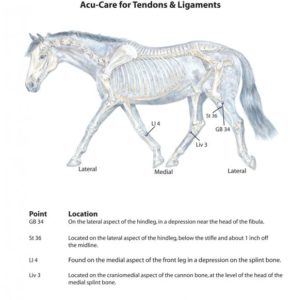
Horses, dogs, and cats need exercise as much and maybe even more than we do. The living body is designed to move so that bones, muscles, tendons, and ligaments stay strong and healthy. Internal organs need movement to function properly. To keep your animals happily on the move it’s wise to pay attention to their tendons and ligaments.
Tendons and ligaments need to be flexible because they are the “rubber bands” which hold the body together. Without these rubber bands the body would be immobile. Each of these soft body tissues performs an absolutely essential and distinct role:
Ligaments are the strong bands, cords or sheets that connect to bones or other anatomical
structures. Ligaments:
• Support joints and hold bones in place
• Support and strengthen other ligaments, and,
• Bind tendons close to joints.
Tendons are cord-like bands that connect muscle to bone. Tendons are involved in
movement: when a muscle contracts, or shortens, the tendon pulls on the bone causing the structure to move.
Your job is to help your animals to keep moving and enjoying their lives. When your horse or dog is fit, he’s less likely to experience injury or illness. And, to keep him fit, his tendons and ligaments need to be both supple and strong. There are a number of ways you can support his general fitness.
Go slowly and warm- up his muscles, joints, tendons and ligaments before heavy exercise. Training on uneven terrain and going up and down hills to develop well rounded and balanced muscling. A weekly acupressure session focusing on flexibility and building strength of tendons and ligaments can greatly enhance your animal’s fitness.
Below are two Acu-Care for Tendons & Ligaments charts identifying acupressure points you can stimulate to consistently support your animal. The canine chart can be used for both dogs and cats. Give you horses, dogs, and cats the benefit of this acupressure session every 5 to 7 days and you will be to enjoy your exercise together.
From Riva’s Remedies: Holly’s Story
Sharing a story from Marijke van de Water of Riva’s Remedies…
Holly’s Laminitis
Holly is a 6 year old Arab mare from B.C., Canada who was afflicted with severe laminitis in all four hooves in May 2012; she was unable to walk or even stand some days and spent days laying with ice packs on all four feet. By June of the same year both Holly’s progress and prognosis were poor. Thus Holly’s owner Diane Armitage contacted Marijke for help in healing Holly’s very sore hoof condition. This case was of interest to Marijke because while the majority of cases of laminitis are caused by feed imbalances, leaky gut, Equine Metabolic Syndrome, lack of movement and/or poor hoof trims, Holly’s case was more complex and her laminitis was multi-factorial.
In addition, other than a two week overdue trim, Holly’s hoof angles and hoof mechanism were acceptable. Because Holly and Diane live several
hours from the Riva’s Remedies health clinic, I conducted Holly’s health assessment by distance using The Marijke Method™, a specific method of kinesiology to identify underlying health issues and to formulate successful health programs. I found that Holly had three issues directly relating to her laminitis:…
Marijke works from her naturalhealth clinic in Armstrong, B.C. where she specializes in helping horses and people. She holds a B.Sc. in Clinical Nutrition and a Diploma in Homeopathic Medicine and Science. She blends her vast knowledge of science, health and nutrition with natural medicine, kinesiology and energy healing. She is considered one of the foremost experts in therapeutic nutrition and equine natural medicine with a special interest in digestive disorders, immunity, laminitis, metabolic syndrome, and emotional and spiritual wellness.
Marijke is also the founder, formulator and CEO of Riva’s Remedies, a herbal and homeopathic product line for horses.
Arthritis in Horses (Part 2 of 2)
Training of horses young early in life, particularly on compacted tracks or arenas, fast gaited and jumping horses are more prone to develop arthritis later in life. Poor conformation and poor farriery can also be a factor, leading to uneven wear and overload on particular tendons and joints. Horses left to develop long toes and lowered heels risk strain and arthritis in the joints.
Nutritional deficiencies also have a bearing on joint health. High grain, rich feeding, an acidic diet, and inadequate calcium or copper in the diet can increase the incidence of bone and joint degeneration.
Action: With Arthritis, prevention is definitely better than cure. Early recognition and care of arthritis is also highly beneficial.
Early stages of arthritis can be settled with topical liniments. Warm poultices and warm bandaging can help to warm up joints and increase mobility. Applied whilst transporting a horse, overnight or prior to gentle exercise, or alternatively after work, to help relieve minor soreness. Armoricaine Clay poultices can be used in this way.
Diet: According to Pat Colby it is not uncommon for the overuse of super-phosphate fertilizers to have a debilitating and depleting affect on the mineral balance of soils. Minerals such as calcium, magnesium and potassiuim should be added to help balance these phosphorus levels.
High grade dolomite is important for treating and preventing arthritis and giving an adequate Calcium and Magnesium supply. Australian seaweed or Kelp (Natrakelp is the most readily absorbed form of liquid seaweed), apple cider vinegar and flax seed meal or flax oil (refrigerated) have healing properties and are good for supporting a balanced diet for your horse.
Cold pressed Linseed oil, Garlic, Chamomile and a mineral or good quality rock-salt lick will also help support your horse.
MSM is a biological sulphur powder that contains a type of sulphur that is often lacking in arthritic sufferers.
Ester C is a non-acidic Vitamin C that can be added to feed to help reduce inflammation and boost immunity. Glucosamine is also used widely now for the treatment of arthritis, and a vegetable form can be sourced.
An acidic or high grain diet is not recommended for arthritic horses.
General Tip: Management and comfort of arthritic horses is important. Suitable rugging will help your horse through the colder periods. Warm paddock boots can also be used where required.
Therapies that support the suppleness and freedom of movement both in preventative and treatment care, are highly beneficial to your horse. This can include qualified and quality Chiropractic work (where required), Acupuncture and regular Massage for your horse. Exercises that support suppleness are also a good idea, and working your horse on gentle, supportive surfaces will increase the longevity of their joints.
Where an accident or injury has occurred, good first aid and follow up treatment lessens the likelihood of arthritic degeneration occurring. A good example of initial treatment might look like this:
- Rescue Remedy or Emergency Essence for shock and trauma
- Homeopathic Arnica for injury
- Rosehip tea with an appropriate mineral supplementation
- Herbs for tissue regeneration and detoxification
- Natural feeding diet to support bone health and general wellbeing
- Adequate rest
I hope some of the ideas in this article have been of use for increasing your understanding of arthritis.
About the author
Zoe Dodds is an Equine Acupuncturist & holistic healer from Australia and the founder of Natural Horse Therapies. www.naturalhorsetherapies.com
Arthritis in Horses (Part 1 of 2)
In my practice, I am often asked about arthritis, in particular with older horses. In this article I will explore some of the symptoms, causes and basic treatment principles applicable to this condition. In future articles, we will explore some of the herbs, homeopathic and essential oil remedies that can be used in cases of arthritis. Your comments and stories are welcomed below.
Symptoms: Arthritis can be classified under two categories: septic and aseptic. Septic arthritis will show visible and obvious lameness and immobility, with swelling and pain. Its onset will be sudden and joints will feel hot to touch. Aseptic on the other hand can take longer to develop and the lameness will come and go initially. The joint will gradually become enlarged and flexion will be restricted.
Stiffness, pain and inflammation in the joints occur indicating degeneration within the joints. Arthritis is often called Degenerative Joint Disease (DJD). It can involve all the structures forming the joint, including the bones, ligaments, capsule and cartilage of the joint. Resistance to movement and lameness is often found increase in both cold and overly damp conditions.
The inflamed joint can appear swollen, warm to touch and resistant to flexing. Erosion of the cartilage and bone can be seen, with the addition of internal bony growths or spurs indicating a more long-term arthritis.
Cause: The causes can be many, but the most common is repeated jarring on hard working surfaces and the wearing of the joints in exercise.
About the author
Zoe Dodds is an Equine Acupuncturist & holistic healer from Australia and the founder of Natural Horse Therapies. www.naturalhorsetherapies.com
FINAL PROOF- Part 2
This shows why the traditional opinion of how hoof mechanism works is completely backwards.
This video contains essential information maximizing your horse’s performance and keeping him sound.
Hoof mechanism is what keeps the hoof alive and frog pressure is what keeps the hoof mechanism alive.
If your horse suffers poor hoof growth, poor horn quality or poor healing capacity the hoof mechanism is most likely out of order.
There is much more information on NoFrog.NoHorse on Facebook.
[youtube]http://www.youtube.com/watch?v=EL_45ml-TlI[/youtube]
FINAL PROOF- Part 1
Thanks to EasyCareInc.com for posting this very interesting video on their Facebook page a few days ago…
This is extremely enlightening and once again opens up the debate of Traditional VS Natural (Barefoot) Hoofcare…
This video shows what could be considered one of the most important breakthroughs in modern hoof research. It proves the complete foundation for the traditional hoof care to be wrong. Since the coffin bone apparently is NOT hanging from the hoof wall the hoof wall should not be forced to carry the horse’s weight.
On the contrary- it would indicate that the hoof wall AS WELL AS frog and sole also need to bear the horse’s weight.
Therefore the practice of traditional hoof care and shoeing is forcing the horses to carry its ENTIRE weight peripherally (on the walls). This can cause significant damage as well of discomfort and even extreme pain.
[youtube]http://www.youtube.com/watch?v=ayEJacuoJ7I&feature=youtu.be[/youtube]
Anne Louise MacDonald: Author & Horse Lover
Last week I did a summery and write-up of Anne Louise’s book “My Natural Horse” so today I decided it would be nice to share a little more about Anne Louise, her horses and what started her in the direction of natural horsecare…
———————
By Anne Louise MacDonald
Just what is natural horse and hoof care?
After 40 years in horses I didn’t have a clue — until 2002…
I had an Arabian horse named Sham. He was ready to retire and I was looking for a second horse. I surfed ads for half-Friesians and found a website called Equinextion with some beautiful horses for sale … and some different stuff about ‘Barefoot and Natural’.
When I’d bought Sham, with his super tall coke-can feet (the fashion in the Arab world), I had him trimmed and shod ever since. I was taught that if I wanted to ride “on that ground” and “that many hours a week”, shoes were necessary.
I didn’t question it … until I started Read the rest of this entry »
Click here to get your free gift!
Privacy Policy:Your email address will never be sold, rented, or given away.